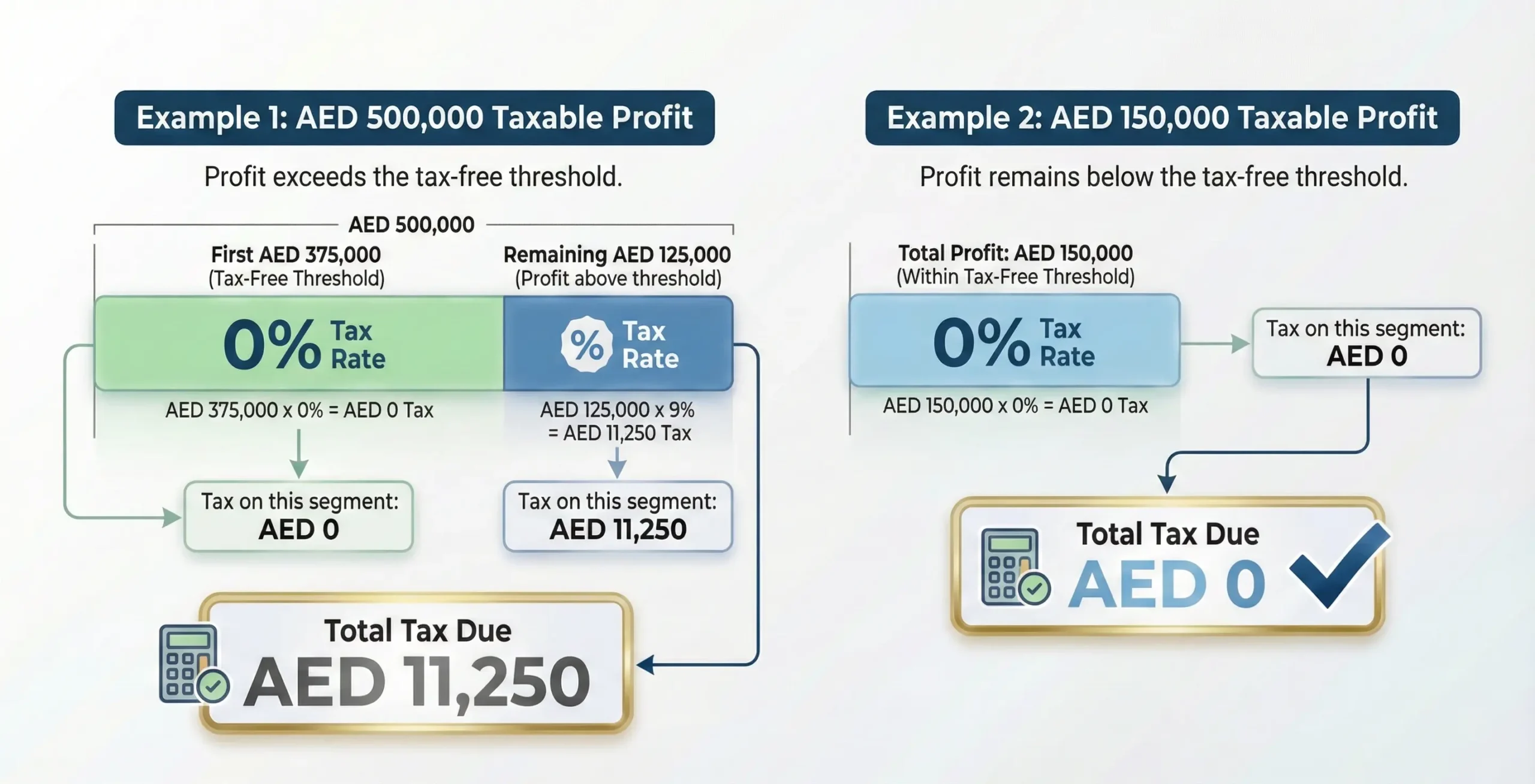
The UAE has officially introduced a federal Corporate Tax for financial years starting on or after June 1, 2023. This applies across all seven emirates and marks a major change in how businesses plan their finances.
Whether your business is on the mainland or in a free zone, this guide helps you understand what’s taxable, what’s not, how much you owe, and how to stay compliant with ease.
Why Did the UAE Introduce Corporate Tax?
The UAE implemented corporate tax to support long-term economic stability, attract global businesses, and align with international tax standards, particularly for large multinational groups.
At the same time, the system continues to support small businesses and startups, offering a 0% tax rate on modest profits.
Who Must Pay Corporate Tax in the UAE?
Corporate Tax applies to:
✓ UAE companies and LLCs
✓ Foreign companies with a permanent establishment in the UAE
✓ Freelancers / individuals running business activities once turnover crosses AED 1 million (exclusions apply)
Even if you don’t owe tax, you must file a return if you fall under the regime.
Does Your Small Business Qualify for Corporate Tax Relief?
The UAE introduced Small Business Relief (SBR) to support startups and SMEs under the Corporate Tax regime, reducing the tax and compliance burden for smaller businesses.
Eligibility:
- Annual revenue of AED 3 million or less
- SBR is optional and must be claimed in your tax return
- Certain businesses may not qualify, including members of large corporate groups or those engaged in specific restricted activities
How SBR Works:
- Eligible businesses are treated as having no taxable income, effectively paying 0% corporate tax
- Filing a tax return is still required
Relief is available until 31 December 2026, subject to government conditions
Tip for Readers: Even if your business qualifies, maintaining proper registration, bookkeeping, and timely filings is compulsory.
Free Zones: Do They Still Have 0% Tax?
Yes, they do, but with specific conditions.
A free zone company may enjoy a 0% Corporate Tax rate only on its Qualifying Income if it is classified as a Qualifying Free Zone Person (QFZP).
- Any Non-qualifying income (e.g., business conducted directly with the UAE mainland) is taxed at the standard 9% rate.
- Compliance is mandatory for all free zone entities, meaning they must register and file a return.
Tip for Readers: Always confirm with your specific free zone authority whether your activities meet the criteria for Qualifying Income.
2025 Update: Minimum Tax for Large Multinationals
Companies that are part of large international groups with €750 million or more in global consolidated revenue may be subject to a 15% minimum top-up tax.
This measure aligns the UAE with global tax standards (Pillar Two rules) and is specifically targeted at large groups, meaning it will generally not affect most startups and Small and Medium Enterprises (SMEs).
How to Pay Corporate Tax in the UAE?
The Federal Tax Authority (FTA) handles corporate taxation. Businesses must:
Apply via the FTA e-services portal to obtain your Tax Registration Number (TRN).
Maintain accurate accounts for profits, expenses & deductions.
Corporate Tax Return must be filed within 9 months of your financial year-end.
Note: Return must be filed even if no tax is due.
If your books are in a different currency, convert into AED before submitting.
Non-compliance? FTA can impose audits, fines, and penalties.
What Expenses Can You Deduct?
Businesses can typically deduct any costs that are:
- Wholly and exclusively for business purposes.
- Supported by proper documentation (invoices, receipts).
Examples include salaries, rent, office utilities, business travel, marketing costs, and depreciation of assets.
What Income is Exempt?
The law provides for several types of exempt or partially exempt income to support cross-border activity and investment. This includes certain types of qualifying dividends and profits from overseas branches.
The specific rules and required documentation for these exemptions should be reviewed with a tax advisor.
How to Stay 100% Compliant?
To ensure your business remains fully compliant and avoids penalties:
- Register early with the FTA to obtain your TRN.
- Track expenses properly and use reliable, up-to-date accounting systems.
- Keep updated as tax laws and regulations continue to evolve.
- Seek guidance immediately for Free Zone rules, group structures, and international transactions.
Simplify Your Corporate Tax Compliance Today!
Want help navigating UAE corporate tax without the stress? Fill out the form below, and our experts will guide you step by step, from registration to filing.
Frequently Asked Questions